INTRODUCTION
A pile of blocks may look simple.
But to a child, it can become a bridge, a tower, a race track, a machine, or an entire city.
That is what makes building toys so powerful.
Children are not just stacking pieces. They are making decisions, testing ideas, and learning what happens when a design works or falls apart.
Every build becomes a small engineering experiment.
In this blog, we’ll explore how educational building toys help children think like young engineers and why construction play is one of the most useful ways to learn through experience.
ON THIS PAGE
- Why building blocks introduce engineering naturally
- How children learn about structure and balance
- Why rebuilding is an important part of learning
- How moving parts add another layer of discovery
- Turning ordinary playtime into a learning experience
WHAT IS THE TOPIC?
Engineering is about solving problems by designing, testing, and improving ideas.
Children already do this naturally when they play with building blocks.
They ask questions without realizing it.
How high can this go?
Why did this fall?
How can I make it stronger?
What happens if I connect these pieces differently?
Building educational toys give children a safe way to explore those questions through hands on experimentation.
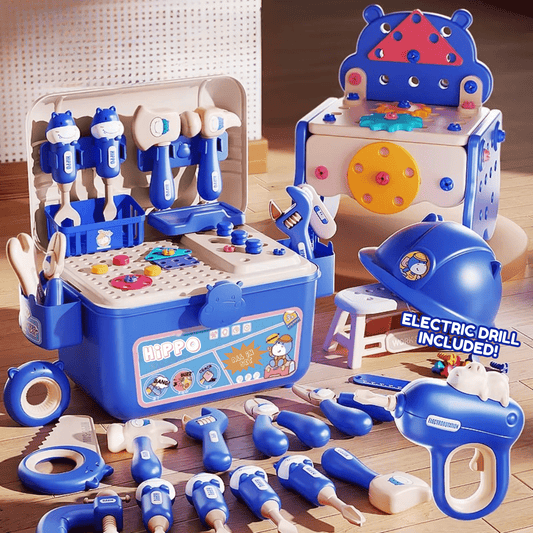
Products such as building blocks, marble runs, gear sets, and modular construction toys make abstract ideas visible and interactive.
WHY IT MATTERS
Young children do not need complicated engineering lessons to begin understanding how things work.
They need opportunities to build.
Construction play introduces concepts such as:
- Stability: Wider or stronger bases can support taller structures.
- Balance: Weight and position affect whether something stays upright.
- Planning: Larger builds often require thinking ahead.
- Cause and effect: Changing one section can affect the entire design.
- Spatial reasoning: Children learn how pieces fit together in three dimensional space.
These lessons happen naturally because children can immediately see the results of their choices.
BUILDING TOYS THAT SUPPORT DIFFERENT SKILLS
1. Classic Blocks for Structure and Imagination
Traditional building blocks encourage children to create without a fixed result.
They can build, take apart, and rebuild as often as they want.
This makes block play especially valuable for developing creativity and spatial thinking.
2. Marble Runs for Cause and Effect
Marble run sets add movement to construction.
Children can experiment with slopes, turns, height, and direction while watching how each design affects the marble.
A small adjustment creates an immediate result, making learning visible.
3. Gear Sets for Mechanical Discovery
Gear building toys help children understand how connected parts influence one another.
Turning one gear can move several others.
This simple interaction introduces mechanical thinking in a way that is easy to see and understand.
4. Modular Tracks for Planning and Experimentation
Flexible track systems encourage children to plan routes and redesign layouts.
They can experiment with curves, elevation, connections, and different pathways.
Each new layout becomes another design challenge.
5. Shape Based Building for Early Geometry
Shape building sets help children recognize patterns, compare sizes, and understand how different forms fit together.
Instead of learning shapes only from pictures, children physically interact with them.
HOW PARENTS CAN ENCOURAGE ENGINEERING THINKING
You do not need to explain every concept.
Instead, ask questions that encourage children to investigate.
Try questions like:
Why do you think that tower fell?
How could you make it stronger?
Can you build another version?
What happens if you move this piece?
Which design works better?
Questions like these help children think about their own decisions without turning playtime into a formal lesson.
CONCLUSION
Building blocks are simple toys with surprisingly big educational possibilities.
Every structure introduces a new challenge.
Every mistake creates another experiment.
Every rebuild encourages children to think differently.
Through construction play, children begin developing the same habits engineers use every day: planning, testing, observing, adjusting, and trying again.
The best part is that it still feels like play.
Sometimes the first step toward understanding engineering is simply giving a child a few pieces and asking:
What can you build?