We've all felt it, that nagging pull toward our phones, the endless scrolling, the mental fog that settles in after too much screen time. In a world dominated by digital distractions, our hands have become passive, our minds restless, and our creative instincts dulled. But there's a powerful antidote that doesn't require expensive courses or complicated equipment: hands-on activities that engage both your mind and body.
Whether you're a complete beginner looking for a new hobby, a parent seeking meaningful activities for your family, or a seasoned maker wanting to deepen your practice, the benefits of tactile, creative work are undeniable. Studies show that working with your hands—building, creating, solving physical puzzles, activates different neural pathways than digital work, improving memory, reducing anxiety, and boosting overall cognitive function.
The beauty of hands-on learning is its accessibility. You don't need to be an artist, an engineer, or a crafts expert to start. You simply need curiosity and the willingness to try something new. From magnetic puzzles that challenge spatial reasoning to tool-based projects that teach practical skills, the world of tactile creativity offers something for everyone.
This isn't about abandoning technology entirely, it's about finding balance. It's about remembering what it feels like to solve a problem with your hands, to see immediate results from your efforts, and to experience the quiet satisfaction that comes from building something real.
In this guide, you'll learn why hands-on activities matter more than ever, discover different types of tactile learning experiences, and get practical steps for incorporating more creative, screen-free time into your daily routine. Whether you have ten minutes or an entire afternoon, there's a hands-on activity waiting to engage your mind and restore your focus.
What Are Hands-On Activities?
Hands-on activities encompass any form of learning or creation that requires physical engagement with materials, tools, or puzzles. Unlike passive consumption, watching videos, reading articles, scrolling social media, hands-on work demands active participation. Your brain must problem-solve in real-time, your hands must execute with precision, and your eyes must coordinate with your movements.
This category includes an enormous range of pursuits: woodworking, puzzle-solving, electronics assembly, crafting, model building, tool-based projects, magnetic and mechanical toys, memory games, and countless other forms of tactile exploration. What they all share is a direct connection between thought and action, between planning and execution.
Hands-on activities can be solitary or social, simple or complex, quick or time-intensive. A five-minute puzzle break engages the same fundamental principles as a weekend-long building project. The scale differs, but the core benefit remains: you're training your brain to think spatially, sequentially, and creatively while keeping your hands busy and your mind focused.
These activities aren't just for children, though that's a common misconception. Adults often benefit even more from hands-on work because it provides a counterbalance to the abstract, screen-based nature of modern professional life. There's something deeply satisfying about seeing tangible results from your efforts, something that's often missing in digital work where your output exists only as pixels on a screen.
Why Tactile Learning Matters in the Digital Age
We're living through the most screen-saturated period in human history. The average adult spends over seven hours daily looking at screens, not counting work-related device time. This constant digital immersion comes with documented consequences: decreased attention spans, heightened anxiety, disrupted sleep patterns, and a general sense of mental fatigue that no amount of scrolling seems to cure.
Tactile learning offers a neurological reset. When you engage in hands-on activities, you activate the sensorimotor cortex, the part of your brain responsible for planning and executing physical movements. This activation creates new neural pathways and strengthens existing ones, effectively giving your brain a different kind of workout than it gets from digital activities.
Research in cognitive psychology shows that physical manipulation of objects enhances memory retention and problem-solving abilities. When you work through a challenge with your hands, navigating a magnetic maze, assembling components, or matching patterns, you're encoding that information through multiple sensory channels simultaneously. This multi-sensory encoding creates stronger, more durable memories than visual information alone.
Beyond the neurological benefits, hands-on activities address a deeper human need: the satisfaction of making and building. We are a species that evolved to create tools, construct shelter, and solve physical problems. When we spend all our time in the abstract realm of digital information, we're denying a fundamental part of our nature. Returning to tactile work, even in small doses, can restore a sense of competence and control that's often missing in our increasingly complex, digitized lives.
For families, hands-on activities provide rare opportunities for distraction-free connection. When everyone is focused on solving a puzzle, building something together, or working on individual projects in the same space, genuine conversation flows more naturally than during forced "quality time" around screens.
The Science Behind Focus and Creativity
Focus and creativity might seem like opposite states, one requiring narrow attention, the other expansive thinking, but they're deeply interconnected, and hands-on activities strengthen both.
The Focus Factor
True focus, what psychologists call "flow state," occurs when the challenge level of a task perfectly matches your skill level. Too easy, and you're bored; too difficult, and you're anxious. Hands-on activities excel at creating this sweet spot because they offer immediate feedback. When you're solving a physical puzzle or working with tools, you know instantly whether your approach is working, allowing you to adjust and maintain that focused state.
Unlike digital tasks that fragment your attention with notifications and hyperlinks, physical activities provide a contained challenge. There's no ping, no pop-up, no algorithmic suggestion pulling you elsewhere. This sustained attention practice literally rewires your brain, strengthening the neural networks responsible for concentration and making it easier to focus on other tasks throughout your day.
The Creativity Connection
Creativity thrives on constraint. When you're working with physical materials or solving tangible puzzles, you're operating within real-world boundaries, gravity, geometry, cause and effect. These constraints force creative problem-solving in ways that digital work, with its infinite undo buttons and template-based solutions, often doesn't.
Hands-on activities also engage what neuroscientists call the "default mode network" the brain state associated with daydreaming, imagination, and creative insight. When your hands are busy with familiar, semi-automatic tasks, your mind is free to wander and make unexpected connections. This is why people often report their best ideas coming while working on creative projects, not while staring at a blank screen trying to force inspiration.
Studies on neuroplasticity, the brain's ability to form new connections, show that learning new manual skills in adulthood promotes cognitive flexibility and creative thinking across all areas of life. The person who learns to navigate a complex magnetic maze or master a new tool isn't just getting better at that specific skill; they're training their brain to approach all problems with greater adaptability and innovation.
Step-by-Step Guide to Building a Hands-On Practice
Step 1: Start With What Intrigues You
The most common mistake people make when trying to incorporate more hands-on activities is forcing themselves into activities that don't genuinely interest them. Sustainability comes from curiosity, not obligation.
Think about moments when you've felt most engaged in the physical world. Do you enjoy solving puzzles? Building things? Creating order from chaos? Understanding how mechanical systems work? Your natural inclinations offer clues about where to start.
If you're drawn to problem-solving and spatial reasoning, something like the TinkerTots Montessori Magnetic Maze – 3 Smart Worlds of Hands-On Learning offers an accessible entry point. These types of magnetic navigation challenges engage your brain in three-dimensional thinking while providing immediate tactile feedback. The beauty of magnetic maze systems is that they're complex enough to hold an adult's attention while remaining approachable for complete beginners.
For those who gravitate toward social connection and memory challenges, pattern-matching activities provide quick, engaging sessions that can involve the whole family. The key is choosing something that sparks genuine interest rather than what you think you "should" be doing.
Step 2: Designate Time, Not Just Space
Many guides emphasize creating a physical workspace for hands-on activities, and while that's valuable, the more critical factor is protecting time. Even if you only have 15 minutes, treating that time as sacred, no phone, no multitasking, transforms the experience.
Start with realistic commitments. Three focused 20-minute sessions per week will build a stronger habit than ambitious plans for daily hour-long sessions that quickly fall apart. Schedule these sessions like appointments. Put them in your calendar. Protect them from the encroachment of other obligations.
Consider pairing hands-on time with existing routines. After dinner, before bed, Saturday mornings, anchor your new practice to an established pattern to increase consistency. The goal isn't to overhaul your entire life; it's to create small pockets of tactile engagement that accumulate into meaningful benefits over time.
Step 3: Embrace the Learning Curve
When you start any hands-on activity, there's an awkward phase where your hands don't execute what your mind envisions. Tools feel foreign. Puzzles seem impossible. Projects take three times longer than expected. This is normal, necessary, and where real growth happens.
Our digital lives have conditioned us to expect instant competence. If something doesn't work immediately, we Google the answer or switch to something easier. Hands-on activities require a different mindset: patience with the process and acceptance of initial clumsiness.
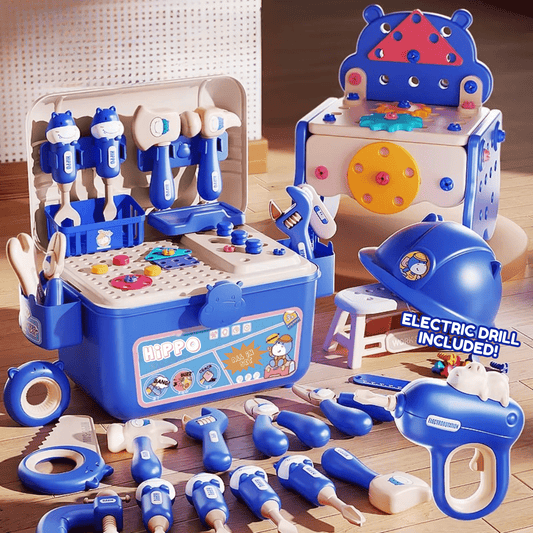
If you're exploring tool-based projects, something like the Hippo All-in-one Tool Hub DIY Montessori Tool Box Set provides a structured introduction to working with real tools. These comprehensive sets typically include everything you need to start building foundational skills without the overwhelm of assembling supplies piecemeal. The Montessori approach emphasizes learning through doing, making mistakes, and discovering solutions through experimentation rather than instruction, exactly the mindset needed for sustainable hands-on practice.
Track small wins instead of focusing on perfect outcomes. Did you spend 20 minutes fully focused? Did you solve one piece of a larger puzzle? Did you learn why a particular approach didn't work? These are all victories worth celebrating.
Step 4: Build Your Challenge Level Gradually
Sustainable hands-on practice requires carefully scaling difficulty. Too much repetition of the same easy task leads to boredom; jumping to expert-level challenges leads to frustration. The sweet spot is incremental progression that keeps you slightly outside your comfort zone.
Start with activities that have adjustable difficulty levels or natural progression paths. Puzzle systems that offer multiple complexity levels, tool projects that build from simple to complex, or creative activities that can be as basic or intricate as you choose provide this built-in scalability.
Memory and pattern-matching games excel at this gradual challenge increase. Something like The Great Memory Flip Off! – Fast-Paced Matching Game for All Ages allows you to compete against yourself, gradually improving your speed and accuracy. These types of games engage your working memory and visual processing in ways that transfer to other cognitive tasks, making them both enjoyable and functionally beneficial.
When an activity becomes too easy, resist the urge to abandon it entirely. Instead, add constraints: work faster, use your non-dominant hand, or teach someone else. These modifications keep familiar activities challenging without requiring entirely new investments of time and resources.
Step 5: Create Social Accountability (Optional but Powerful)
While hands-on activities can be deeply satisfying as solo pursuits, adding a social element often increases both consistency and enjoyment. This doesn't mean you need to join formal groups or classes, simple accountability with friends or family can be equally effective.
Share your practice with someone who will check in: "How's your project going?" Regular, low-pressure accountability helps during the inevitable motivation dips that affect any new habit. Consider scheduling parallel creative time with a friend or family member, even if you're working on different activities. The shared commitment and energy make individual practice more sustainable.
For families, hands-on activities offer rare opportunities for cross-generational engagement. Unlike many modern activities that segregate by age, tactile challenges can engage everyone from school-age children to grandparents. The key is choosing activities with scalable complexity so everyone feels appropriately challenged.
Group puzzle-solving, collaborative building projects, or friendly competitions around memory games create shared experiences without the passive consumption of screen-based entertainment. These shared creative sessions often produce the spontaneous conversations and genuine connection that make families feel close.
Step 6: Reflect on the Benefits You're Experiencing
After several weeks of consistent hands-on practice, take inventory of what's changing. Are you sleeping better? Feeling less anxious? Finding it easier to focus on other tasks? Experiencing more creative ideas in other areas of life?
These benefits often appear subtly, so intentional reflection helps you notice and appreciate them. Consider keeping a simple log, nothing elaborate, just notes about what you worked on and how you felt afterward. Over time, patterns emerge that help you understand which activities provide the most value for you personally.
Don't be surprised if the benefits extend beyond what you expected. People often report that adding hands-on activities to their routine improves their performance at work, enhances their relationships, and provides a sense of accomplishment that was missing from their increasingly digital lives.
Different Types of Hands-On Activities for Every Skill Level
Puzzle and Navigation Activities
These activities emphasize problem-solving, spatial reasoning, and hand-eye coordination. Magnetic mazes, mechanical puzzles, logic games, and navigation challenges fall into this category. They're ideal for people who enjoy systematic thinking and clear solutions, and they work perfectly in short time blocks.
Tool-Based Building Projects
From simple assembly to complex construction, tool-based activities teach practical skills while engaging both mind and body. Starting with age-appropriate tool sets that include safety features and clear projects helps build confidence before advancing to more complex work.
Memory and Pattern Recognition
These activities strengthen cognitive function while providing quick, engaging sessions. They're excellent for people who have limited time but want meaningful mental engagement. Fast-paced matching games, memory challenges, and pattern completion activities fit this category.
Creative Crafting
Drawing, painting, sculpting, knitting, woodburning, jewelry making, the realm of creative crafts offers infinite variety. These activities emphasize self-expression over problem-solving and appeal to people who enjoy open-ended creation.
Electronics and Circuitry
For those fascinated by how things work, electronics kits and circuit-building activities provide hands-on engagement with technology. These bridge the gap between digital and physical, showing the tangible reality behind our screen-based world.
Model Building and Assembly
Whether it's scale models, miniatures, or modular building systems, assembly activities combine planning, precision, and patience. They're ideal for people who enjoy seeing clear progress and working toward a defined end result.
Creating a Dedicated Space for Creative Work
While you don't need an entire room, having a designated spot for hands-on activities reduces friction and increases consistency. This can be as simple as a drawer, a shelf, or a corner of a table, somewhere that keeps your materials organized and accessible.
The key is to eliminate setup barriers. If you have to spend 20 minutes finding supplies every time you want to work on something, you'll simply stop doing it. Everything you need for your chosen activity should be in one place, ready to go.
Consider portability as well. A tackle box, toolbox, or storage bin that contains a complete activity kit allows you to work in different locations, the patio, the living room, even traveling. This flexibility prevents the "I can only do this in one specific spot" thinking that limits practice.
Lighting matters more than you might think. Good task lighting reduces eye strain and makes detailed work more enjoyable. If your dedicated space has poor lighting, a simple desk lamp dramatically improves the experience.
Overcoming Common Obstacles
"I don't have time."
This is the most common objection, and it's worth examining honestly. Most people spend significant time on activities that don't genuinely refresh or engage them, scrolling social media, watching forgettable television, or other passive consumption. The question isn't whether you have time, but whether you're willing to redirect some existing time toward something more fulfilling.
Start absurdly small. Even five minutes of focused hands-on activity provides benefits. Once the habit is established, expansion happens naturally.
"I'm not creative/coordinated/skilled enough."
Hands-on activities aren't about demonstrating existing skill; they're about developing new capabilities. Everyone starts as a beginner. The person who seems naturally talented has simply spent more time practicing. Your initial awkwardness is evidence of growth, not inadequacy.
Choose activities with low stakes. You're not building furniture for sale or competing in championships, you're engaging your mind and hands for your own benefit. Release the need for perfect outcomes.
"It seems expensive."
While some hands-on hobbies can become expensive, getting started rarely requires significant investment. Many activities use common household items or inexpensive starter sets. The cost-per-hour of engagement for quality hands-on activities often far exceeds the cost-per-hour of other entertainment options.
Focus on depth rather than breadth initially. Master one activity before acquiring supplies for others. This approach prevents the accumulation of unused materials while building genuine skill.
"I lose interest quickly."
This often indicates mismatched activity choice rather than a character flaw. If your first attempt at hands-on activity doesn't hold your interest, try something fundamentally different. The person who bounces off woodworking might love puzzle-solving. The person who finds crafting tedious might thrive with tool-based projects.
Also consider whether you're attempting projects that are too complex too soon. Interest wanes when frustration exceeds engagement. Scale back to activities that challenge without overwhelming.
Frequently Asked Questions
How long does it take to see benefits from hands-on activities?
Most people notice improved focus and reduced stress within the first few sessions, sometimes immediately. The mental reset that comes from 20 minutes of focused, tactile work is often apparent right away. Longer-term cognitive benefits, like improved memory and creative problem-solving, typically become noticeable after several weeks of consistent practice. The key word is consistent, three 20-minute sessions per week will produce more benefits than sporadic marathon sessions.
Can adults really benefit from activities designed for learning?
Absolutely. The Montessori principle that humans learn best through hands-on exploration applies across the entire lifespan, not just childhood. In fact, adults often benefit more because they're consciously choosing to engage rather than being required to do so, and they can better appreciate the cognitive shifts happening during practice. Activities that develop fine motor skills, spatial reasoning, and problem-solving are valuable at any age.
What if I have limited hand mobility or dexterity?
Many hands-on activities can be adapted for different physical capabilities. Magnetic-based activities often require less fine motor precision than traditional puzzles. Large-piece puzzles, modified tool handles, and voice-activated assembly guides expand accessibility. The key is finding activities that challenge without causing pain or excessive frustration. Occupational therapists can often recommend specific adaptations for individual needs.
How do I choose between different types of hands-on activities?
Start with honest self-assessment. Do you prefer structured or open-ended activities? Solo or social engagement? Quick sessions or extended projects? Clear solutions or creative exploration? Your answers point toward specific categories. Try one activity from your preferred category for at least three sessions before deciding it's not for you, first attempts are rarely representative of the actual experience once you develop basic competence.
Can hands-on activities help with anxiety or stress?
Research strongly suggests yes. The combination of focused attention, physical engagement, and tangible progress creates what psychologists call "productive distraction",your mind is occupied with the task at hand rather than looping through anxious thoughts. The repetitive motions involved in many hands-on activities have a meditative quality that reduces cortisol levels. Additionally, the sense of accomplishment from completing even small projects provides a mood boost that counteracts stress.
Should I work on multiple activities simultaneously or focus on one?
For building initial habit strength, focusing on one activity for at least a month is generally more effective than fragmenting your attention. Once the habit is solid, adding variety prevents boredom and exercises different cognitive skills. Consider having one primary activity you practice regularly and one or two secondary activities for when you want variety or when your primary activity isn't practical given time or space constraints.
Getting Started Today
The best hands-on practice is the one you'll actually do consistently. It doesn't need to be impressive, expensive, or perfectly optimized, it just needs to get your hands moving and your mind engaged.
Choose one activity from this guide that genuinely interests you. Block out 20 minutes in the next 48 hours. Gather whatever simple materials you need. Then start, expecting to be mediocre at first, knowing that mediocrity is the essential first step toward competence.
The world won't stop demanding your digital attention. Work won't stop generating emails. Social media won't become less addictive. Creating space for hands-on activities requires deliberate choice in an environment designed to keep you scrolling, clicking, and consuming.
But the rewards are worth the effort. The quiet satisfaction of solving a physical puzzle. The visible progress of a building project. The mental clarity that follows focused creative work. The memory of laughing with family over a competitive game rather than staring at separate screens. These experiences reconnect you with fundamental human needs that modern life often overlooks.
Your hands are capable of remarkable things. Your mind craves challenges beyond digital stimulation. Start small, stay consistent, and watch as hands-on engagement transforms not just your free time, but your relationship with focus, creativity, and the physical world itself.
The tools and activities are ready. The only question is whether you're ready to build something—starting with a better balance in your own life.