Screens have become the default solution for boredom, learning, and even relaxation. But too much screen time often leaves people feeling restless, unfocused, and disconnected from real creativity.
Many adults and families notice the same pattern: attention spans feel shorter, patience runs thin, and the desire to actually make something gets buried under constant digital noise.
At the same time, there’s a growing urge to bring back hands-on experiences—activities that involve thinking, building, testing, and adjusting with your own hands.
Building things, even simple structures, taps into something deeply human. It slows the mind, encourages focus, and replaces passive consumption with active creation.
In this guide, you’ll learn how to encourage hands-on building skills at home in a way that feels natural, engaging, and sustainable without turning it into another chore.
WHAT IS THE TOPIC?
Hands-on building is the practice of learning through physical construction, connecting pieces, assembling parts, experimenting with structure, and solving problems through trial and error.
Unlike passive activities, building requires active thinking. You plan, test, adjust, and rebuild. This process strengthens spatial awareness, patience, and confidence across all ages.
Hands-on building isn’t limited to one age group or skill level. Beginners, hobbyists, adults, and families can all benefit from activities that encourage curiosity and creativity through physical engagement.
WHY IT MATTERS
Modern life prioritizes speed and convenience, but real learning often happens more slowly.
Hands-on building matters because it:
-
Strengthens focus by requiring sustained attention
-
Encourages creativity through open-ended exploration
-
Builds problem-solving skills by allowing mistakes and iteration
-
Supports mindfulness through tactile, repetitive actions
-
Promotes confidence as ideas turn into tangible results
Building something even something small creates a sense of ownership and accomplishment that screens rarely provide.
STEP-BY-STEP GUIDE
1) Create space for building without distractions
Explain first:
Hands-on building works best when it has its own time and space. This doesn’t require a dedicated workshop just a clear surface and a short, intentional window of time.
Turning off notifications and clearing visual clutter helps the brain shift into a focused, creative mode.
2) Start with simple, modular activities
Explain first:
Modular building encourages experimentation. When pieces can be rearranged, builders feel free to test ideas without fear of “getting it wrong.”
This flexibility keeps frustration low and curiosity high.
Natural product mention (1):
A modular system like WonderRail™: The Modular 3D Train Track for Curious Little Builders naturally supports this approach, allowing builders to redesign layouts, test movement, and explore cause-and-effect through hands-on play.
3) Encourage problem-solving over perfection
Explain first:
The goal of building isn’t a flawless result it’s the thinking that happens along the way. Encourage questions like “What happens if we change this?” or “How could this be more stable?”
Mistakes are not setbacks; they’re learning moments.
Natural product mention (2):
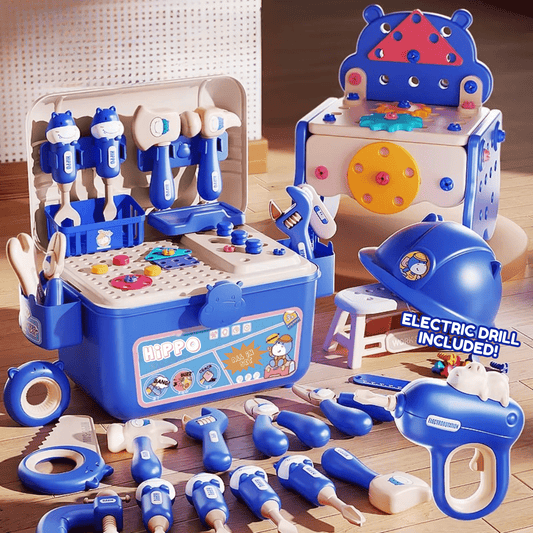
Tool-based building sets such as the Little Engineer DIY Montessori Tool Box Set help reinforce this mindset by focusing on assembly, adjustment, and understanding how parts work together.
4) Adjust challenges to match interest and ability
Explain first:
Hands-on building should feel engaging, not overwhelming. Start with basic structures, then gradually add complexity as confidence grows.
This keeps builders motivated and prevents burnout.
Natural product mention (3):
A versatile option like the Hippo All-in-one Tool Hub DIY Montessori Tool Box Set allows for varied projects at different difficulty levels, making it easier to adapt challenges over time.
5) Reflect and reset after each session
Explain first:
Ending a building session with a brief reflection reinforces learning. Talk about what worked, what didn’t, and what could be tried next time.
Cleaning up together also signals closure and makes it easier to return to the activity again.
FREQUENTLY ASKED QUESTIONS
1) Is hands-on building only for kids?
No. Hands-on building benefits adults, teens, hobbyists, and families by improving focus, creativity, and problem-solving skills.
2) How long should building sessions last?
Short sessions around 20–40 minutes are often ideal. They allow deep focus without fatigue.
3) What if someone loses interest quickly?
Start with open-ended activities and low pressure. Interest often grows as confidence and familiarity increase.
4) Do building activities need to be educational?
They don’t need to feel educational to be effective. Learning happens naturally through exploration and experimentation.
5) Can this replace screen-based learning?
It doesn’t need to replace it entirely. Hands-on building works best as a balance, adding depth and engagement alongside digital tools.
Hands-on building brings creativity back into everyday life by turning ideas into something real and tangible.
By making space for building, choosing flexible activities, and focusing on the process rather than the outcome, you create an environment where curiosity and confidence can grow naturally.
If you’re looking for a way to unplug, slow down, and build something meaningful together, starting with hands-on building is a powerful place to begin.