Drop a marble at the top of a track, and in about ten seconds it shows you more physics than a textbook chapter. Gravity, energy, friction, momentum and simple machines all work together every time it rolls.
That's why marble runs are one of the best hands-on learning tools for curious kids and adults alike. Here's what's actually happening inside the track, and how building one makes those ideas click.
Gravity starts the show
Every run begins with potential energy. A marble sitting at the top of the track holds stored energy because of its height. The higher it starts, the more energy it has to spend.
The moment it rolls, gravity converts that stored energy into kinetic energy, the energy of motion. Steep drops convert it fast, so the marble speeds up. Gentle slopes convert it slowly, keeping the marble under control.
Ask a young builder to predict which section will be fastest, then watch. They're testing a hypothesis without even realizing it.
Lifts, cranks and motors: simple machines at work
A marble can't roll uphill on its own, so every continuous run needs a way to carry it back to the top. That's where simple machines come in.
The Marble Spaceport Marble Run lets builders try this two ways. Turn the hand crank, a classic wheel and axle, and you feel the work it takes to lift each marble. Switch to electric mode and a 70 rpm motor takes over, driving vertical lifting stairs that pass marbles upward step by step in a zigzag path.
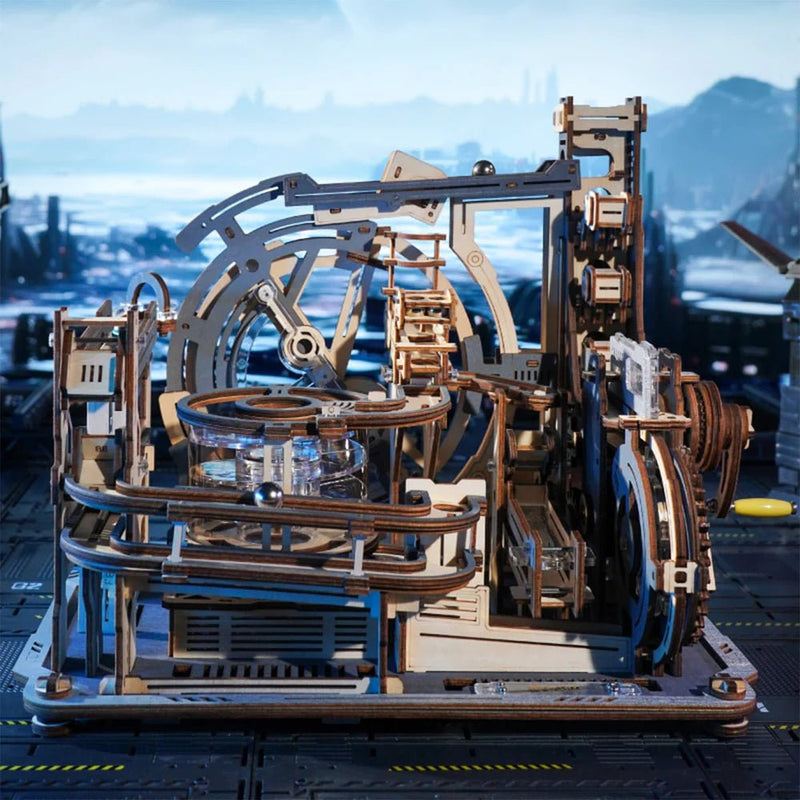
The Marble Spaceport: lifting stairs carry marbles up, and the clear acceleration spiral shows the speed building on the way down.
The Neon Circuit City Marble Run DIY Kit uses an electric lift module to return marbles to the top for nonstop, cyclical running. It's a clear example of a motor putting back the energy gravity spent.
Spirals, funnels and the pull of a curve
Curves add a new lesson: momentum. A rolling marble wants to keep moving in a straight line, so the track wall has to push it inward to make it turn. In a funnel, like the one in the Marble Parkour Big Funnel Run MR-1, the marble circles faster as it drops toward the narrow center, just like water swirling down a drain.
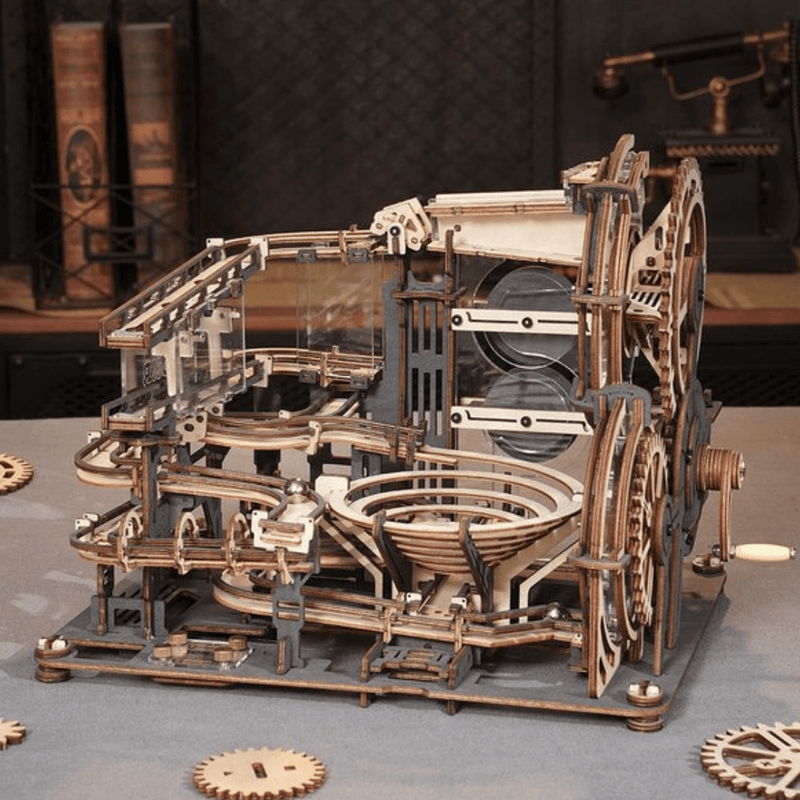
The Marble Run Night City: watch the marble speed up as it circles down the funnel toward the center.
Friction matters too. Smooth tracks keep friction low, so marbles carry their speed through long courses, like the 187 cm track in Neon Circuit City's The Last City design. On the Marble Spaceport, a transparent acceleration spiral lets you watch the speed build in real time.
Choosing the right marble run
The best kit depends on how much time and patience your builder brings.
- Quick build, big glow: Neon Circuit City has 130 to 140 pieces and takes about 90 minutes. Its neon city modules connect side by side or stacked, so the run grows with your collection.
- The deep build: Marble Spaceport has 472 pieces and takes about 5.5 hours, with no glue needed. It also links with the Marble Run Night City so marbles travel between both models in one loop.
- Mechanism explorers: The Fortress Climber MR-2, Swingback Explorer MR-3 and Trapdoors Squad MR-4 each center on a signature mechanism you can study as it runs.
Start building
Every marble run is a working physics lab you build with your own hands. Browse the full DIYative Marble Run collection, pick the kit that matches your builder's curiosity, then drop the first marble and ask the best science question there is: why did it do that?